alpha50: The Math Behind the Hive

Copy-trading sells a fantasy: find the one genius, mirror their wallet, get rich. The reality is that a single wallet is a single sample. You cannot tell skill from luck on one path, and the day your genius blows up is the day you blow up with them. You inherit their tilt, their venue-specific edge, their 3 a.m. revenge trade — all of it, at full size.
alpha50 starts from the opposite premise. There is a result in portfolio theory, more than half a century old, that turns many imperfect signals into one good one. Ray Dalio's Bridgewater called it the Holy Grail of investing. Almost nobody has applied it to copy-trading, because almost nobody had a clean, real-time, verifiable feed of skilled traders to apply it to. On-chain perps changed that.
This piece is the math, end to end: why diversification is the only free lunch in markets, why a curated crowd of traders is the ideal place to spend it, and how you turn fifty live conviction signals into a single, risk-managed position.
The thesis in one sentence: alpha50's edge is statistical, not predictive. It does not forecast price. It harvests the variance reduction of an ensemble of skilled-but-noisy signals — and the entire game is the correlation between them.
1. The Holy Grail of Investing
Dalio's insight is deceptively simple. Take return streams that each have a positive expected return and roughly similar risk. As you add streams that are not correlated with each other, the return of the portfolio stays the same, but the risk falls — fast. Stack fifteen genuinely uncorrelated streams and you can cut volatility by around 80% without giving up a basis point of expected return.
The mechanism is just how variance adds. For equally-weighted streams, each with volatility and average pairwise correlation , the portfolio's risk is:
Two things fall out of that square root, and they are the whole story.
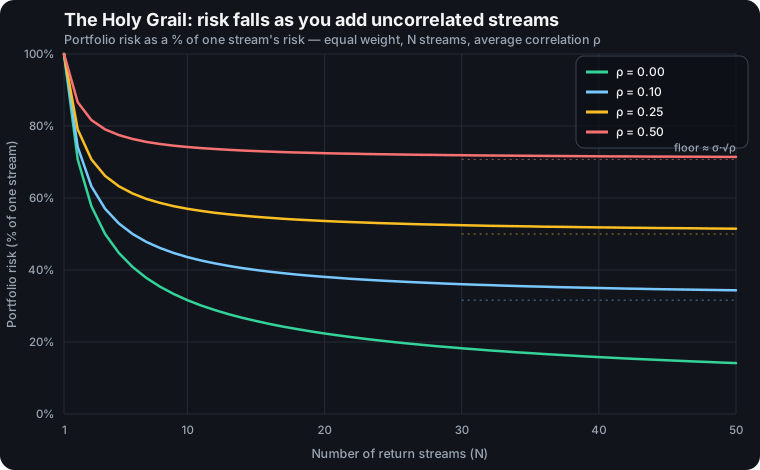
Add streams and risk drops — but each curve flattens onto a floor of σ·√ρ. With ρ = 0.25 you cannot get below ~50% of a single stream's risk no matter how many you add.
First: when ρ is near zero, risk decays like 1/√N — the classic diversification curve crashing toward zero. Second, and more important: as N grows, portfolio risk does not go to zero. It converges to a floor of σ·√ρ. Correlation, not count, sets the floor. Fifty streams at ρ = 0.25 are no safer than ten at ρ = 0.25. Diversification is bounded by correlation, full stop. Hold that thought; it dictates everything about how the cohort is built.
2. Traders Are Return Streams — Better Ones Than Asset Classes
Dalio was diversifying across asset classes. That is hard, because there are only so many of them and they tend to hug each other when it matters. A skilled trader is a far better primitive. Each one is a strategy — a live, adaptive return stream with a positive expected drift that has already survived a battery of out-of-sample reality: real fills, real drawdowns, real funding paid.
And on-chain, the universe is enormous. From the ~13,000 wallets we index on Hyperliquid, a few hundred clear strict skill gates. That surplus is the luxury that makes the Holy Grail work: we are not forced to take whoever is available, the way an asset allocator is. We can select for decorrelation. A momentum scalper on majors, a mean-reversion desk on mid-caps, a stock-index swing trader on HIP-3, a funding-carry specialist — these are different bets, not different flavors of the same beta. That is the raw material the math wants.
We are diversifying alpha, not stacking beta. That distinction is the reason this works at all.
3. From Risk Reduction to Sharpe Amplification
Flip the same equation around. If each member has skill — a per-trade Sharpe of S — then aggregating N of them with average correlation ρ produces a portfolio Sharpe of:
is the entire value proposition compressed into one number: how many times the hive's risk-adjusted return beats the average member's. This is the chart that matters.
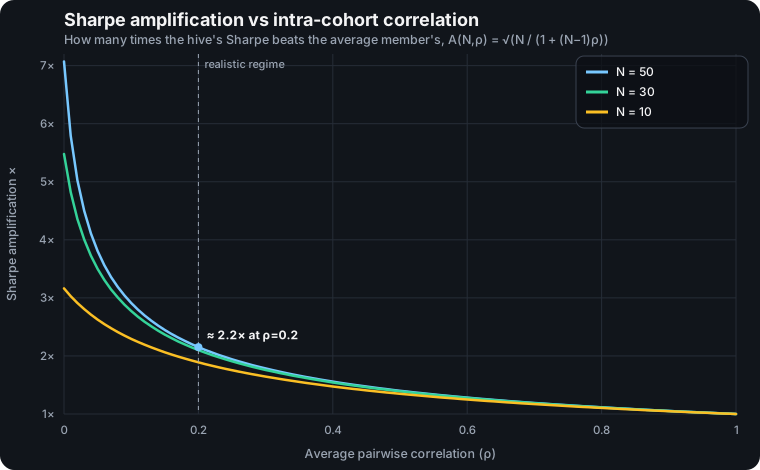
At ρ = 0 the factor is √N — about 7× for fifty wallets. At realistic correlation it is far lower, but still decisively above 1.
Run the numbers honestly. Perfect independence (ρ = 0) gives √50 ≈ 7.1×, but that is a fantasy — skilled traders share some exposure to the same market. At a realistic average correlation of ρ ≈ 0.2, the factor is still about 2.1×. A cohort of mediocre-individually traders, each at Sharpe 1.0, becomes a Sharpe-2 book. That is the difference between a strategy nobody allocates to and one a desk fights to get into.
| Average correlation ρ | Amplification, N = 50 |
|---|---|
| 0.00 (independent) | 7.1× |
| 0.10 | 2.9× |
| 0.20 (realistic) | 2.1× |
| 0.30 | 1.8× |
| 1.00 (identical) | 1.0× |
4. Building the Hive Is a Decorrelation Problem, Not a Leaderboard
Here is where most "copy the top traders" products quietly fail, and where the math forces a non-obvious design.
The naive move is to rank every eligible wallet by Sharpe and take the top fifty. That is wrong. If your top fifty are all momentum traders riding the same majors, their ρ is 0.7 and your amplification is ~1.2× — you have built an expensive, leveraged version of one trader. Ranking maximizes individual quality and ignores the only variable that actually governs the payoff.
The right objective is the effective number of independent bets:
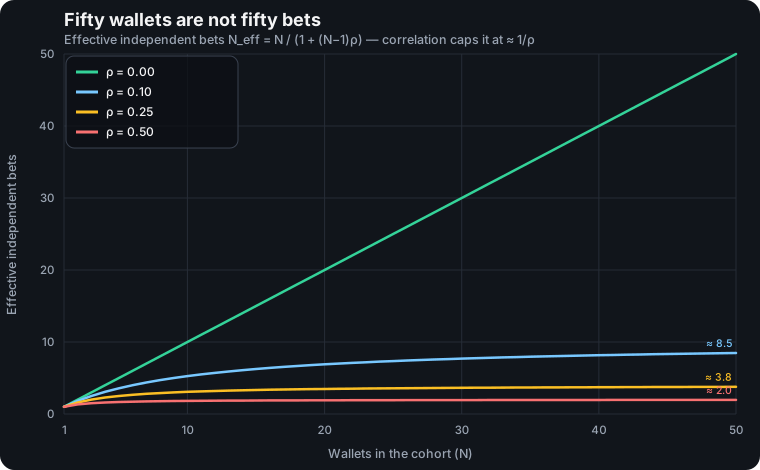
Fifty wallets at ρ = 0.25 are worth fewer than four independent bets. Selection has to fight for decorrelation, not headcount.
Fifty wallets at ρ = 0.25 give you fewer than four effective bets. So cohort construction is a portfolio-optimization problem: maximize N_eff subject to a skill floor, not maximize average skill. In practice that means clustering candidates into strategy archetypes by the correlation of their return streams and their instrument exposure, then drafting the best survivor from each cluster — deliberately trading a little individual Sharpe for a lot of independence. A wallet that is the eighth-best momentum trader but the only funding-carry specialist is worth more to the hive than the third-best momentum trader.
Two more quant disciplines belong here, because raw selection overfits:
- Shrinkage. A wallet's measured Sharpe is an estimate, and estimates of the highest Sharpes are the most inflated by luck (the winner's curse). Shrink each member's Sharpe toward the cohort mean — a James–Stein / empirical-Bayes pull whose strength scales with how few trades back the estimate. You stop paying full weight for a hot streak.
- Correlation is estimated, too, and it is non-stationary. Use a shrunk covariance estimator (Ledoit–Wolf) so the selection is not chasing spurious decorrelation that evaporates next week.
The cohort is then re-evaluated continuously, with hysteresis: a wallet has to fall well past the cutoff before it is dropped, so the book is not churned by rank noise around the boundary.
5. Turning Consensus Into a Position
Aggregation only pays if you translate it into exposure without re-introducing the single-wallet risk you just diversified away. The signal for each instrument is a signed, conviction-weighted, risk-normalized consensus:
Where, for each cohort wallet holding instrument :
- — the side they are on (long or short).
- — conviction: position size relative to their own book.
- — the shrunk-Sharpe weight: below , ramping to by .
- — the risk-parity scalar: equal risk, not equal dollars.
- — the per-wallet contribution cap, so no single whale carries the book.
Every term is doing load-bearing work. Conviction reads position size relative to the trader's own equity, so a whale putting 40% of their book on a name speaks louder than one dipping a toe. The Sharpe weight down-weights the lucky. Risk parity is the part naive copiers skip: you scale by risk, not dollars, so a 120-vol memecoin position does not silently dominate a BTC position of the same notional. The cap is what enforces the thesis — no single wallet can move the signal far on its own, so it takes genuine multi-wallet agreement to build size. That agreement, confluence, is the practical proxy for "this is real alpha and not one trader's idiosyncrasy."
Two refinements a serious implementation owes the model:
- Funding-adjusted edge. On perps, carry is real money. A crowded long paying 60% annualized funding has a lower net expected return than the raw price signal implies; net it out before sizing.
- Cost-basis matching. You always enter after the cohort — the follower drag, the tax on this whole enterprise. Enter on fresh opens, near where the cohort actually opened, rather than chasing a move that is already 5% old. It keeps your risk identical to the trader whose signal you are taking, and it is the difference between capturing the edge and donating it to the spread.
6. Sizing: Volatility Targeting and Fractional Kelly
A signal tells you direction and confidence. It does not tell you how much. Getting size wrong is how strategies with real edge still die.
Two layers. First, volatility targeting at the portfolio level: pick a target risk — say 15% annualized — and scale gross exposure inversely to realized volatility.
When markets get violent, realized vol rises and the book automatically shrinks ( falls). Your risk experience stays roughly constant instead of ballooning exactly when conditions are worst.
Second, fractional Kelly on signal intensity. Kelly says the growth-optimal bet scales with edge over variance, . Full Kelly is famously too aggressive — it assumes you know exactly, and you never do. Estimation error is brutal at the top, so size at a fraction (half-Kelly or less): bet more when the consensus is strong and broad, less when it is thin, and never the whole stack on any one read. Strong signal, many uncorrelated voices agreeing, low funding — that is when you press. A lone whale on a thin signal barely registers.
7. When the Grail Breaks: Correlation Risk
Now the honest part, the part a marketing deck leaves out. The Holy Grail has one failure mode, and it is structural: ρ is not constant. In a crisis, everything correlates. The skilled momentum trader, the mean-reversion desk, the stock-index swinger — in a violent liquidation cascade they are all just long risk, and they all bleed together. ρ rushes toward 1, and exactly when you need diversification most, A(N, ρ) collapses toward 1×.
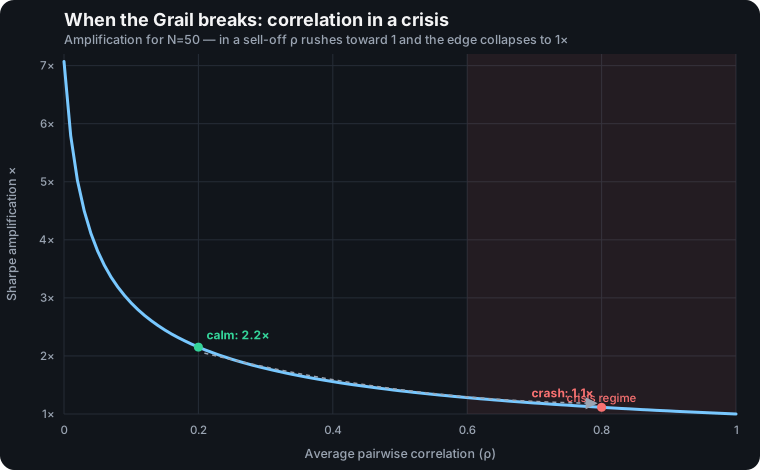
The same fifty-wallet curve. A calm-regime 2.1× edge can fall to ~1.1× when correlation spikes. The diversification does not "fail" — it does exactly what the math says, which is why the risk layer cannot be optional.
This is not a flaw to paper over; it is the reason risk management is a first-class citizen, not a bolt-on. The defenses have to be dynamic and correlation-aware:
- Monitor realized intra-cohort correlation in real time. When ρ jumps — the regime-shift tell — cut gross, tighten the vol target, and treat the consensus as lower-information until it normalizes.
- Hard backstops underneath the soft ones: per-position stop-losses, and a portfolio-level drawdown circuit that flattens and pauses new risk after a daily loss threshold. These bound the tail; they do not try to predict it.
The strategy is not designed to avoid tail damage. It is designed to bound it, survive it, and still be standing to compound the 2× edge the other 95% of the time.
8. The Model on Live Data: The Last 30 Days
Theory is cheap. So here is the cohort's last thirty days on Hyperliquid, treated exactly the way the model treats them: each wallet's realized daily P&L, normalized by its account value, becomes a return stream; the streams are combined into one equal-weight book — the hive. Thirty of the fifty wallets traded enough in the window to register a stream.
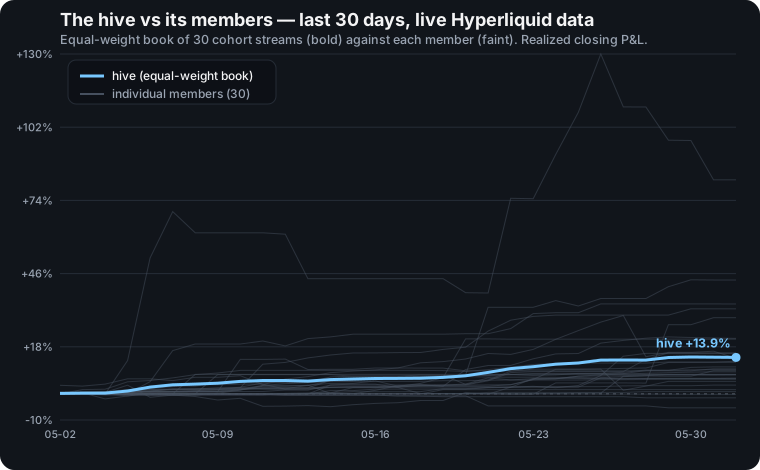
Each faint line is one cohort member; the bold line is the equal-weight book. The members scatter — some rip, some chop sideways. The hive is the smooth path threading through them: most of the upside, a fraction of the wobble.
| Last 30 days · 30 active wallets | The hive | Median member |
|---|---|---|
| Cumulative return | +13.9% | +9.2% |
| Worst drawdown | −0.2% | −0.7% |
| Realized correlation ρ̄ | ≈ 0.01 (cohort average) | — |
| Sharpe amplification | ≈ 3.4× the average member | baseline |
The headline is not the return — it is the shape. The hive earned more than the typical member while taking roughly a third of the drawdown, which is the Holy Grail doing exactly what the algebra promised: same drift, far less noise. The realized amplification of ~3.4× lands below the theoretical ceiling of ~4.9× implied by the measured correlation — finite-sample reality, not free-lunch fantasy.
Read it with the caveats it deserves. This is realized closing P&L: it ignores the mark-to-market of still-open positions, so the absolute volatility — and therefore the absolute Sharpe — is understated and not a tradeable figure. What is robust is the ratio, because numerator and denominator are computed the same way. And the measured ρ ≈ 0.01 is almost certainly an underestimate of the true economic correlation — closing events are sparse and rarely line up day-to-day — which is precisely why §7's tail, where correlation snaps toward one, remains the risk that matters. One calm month is an illustration, not a stress test.
9. The Two Sides of the Trade
For the depositor. You get something that previously required a quant desk: a diversified, risk-targeted, continuously-rebalanced book of verified on-chain alpha — without picking wallets, watching charts, or learning what a Ledoit–Wolf estimator is. Exposure stays non-custodial; the engine signs trades, never withdrawals. The pitch is not "copy a genius." It is "own the ensemble, with the risk engineered."
For the protocol. The model adds no token emissions and makes no price forecast. It is a smarter allocation of risk across signals that already exist, run transparently and automatically, with fees that align to activity and performance rather than a flat rent. Informed, aggregated flow is also, quietly, good for price discovery on the venues it trades.
10. Limitations and Capacity
No honest quant piece ends without the caveats:
- Follower drag is a permanent tax. Amplification has to clear it net of fees and slippage; on thin HIP-3 books especially, execution quality, not signal quality, decides the P&L.
- Capacity and reflexivity. Edge decays with size. Mirror too much capital and you move the very markets you are reading, and the signal crowds. The strategy has a finite AUM ceiling and sizing has to respect it.
- Estimation error and survivorship. Every Sharpe, every correlation, every cluster boundary is estimated from finite, noisy, partly-overfit history. Shrinkage helps; it does not cure.
- The ρ-spike tail, covered above, is the dominant risk and the one the entire risk layer exists to bound.
Conclusion
alpha50 is not an attempt to out-predict the market. It is an attempt to engineer the oldest free lunch in finance — diversification across uncorrelated, positive-edge return streams — onto a return stream the world had never packaged: the live, verifiable conviction of the best traders on-chain.
The edge lives in the correlation structure. Build the cohort to minimize it, weight by risk and shrunk skill, size by volatility and fractional Kelly, and stand guard for the regime where correlation betrays you. Do that, and fifty noisy, fallible, individually-beatable traders become one signal that is hard to beat.
That is the Holy Grail. We just found a new place to spend it.